

Salta al contenuto principale
Home
  • English
  • Deutsch
  • Italiano
  • Other languages

User account menu

  • Accedi

User login

CAPTCHA
Questa domanda è un test per verificare che tu sia un visitatore umano e per impedire inserimenti di spam automatici.
  • Crea nuovo profilo
  • Reimposta la tua password

Main navigation

  • Azienda
    • Chi siamo
    • Gestione
    • Storia
    • Qualità/ambiente
    • Conformità
  • Product Catalogue
    • LED Lamps
    • Control Gear, LED Drivers
    • LED Strips
    • Smart Lighting - Lighting Control Components
    • LED Luminaires
    • Discharge lamps
    • Fluorescent lamps
    • Halogen and Incandescent Lamps
    • Export/ Non-EU
    • Signal Lamps
    • Lampade UV di Radium TECH (en inglese)
    • Riflettori speciali a emissione di luce visibile di Radium TECH (en inglese)
    • Emettitori a infrarossi di Radium TECH
  • Gruppi di prodotti
    • NOVITÀ! Luci a LED
    • Strisce LED, LED-Strips
    • Strisce LED Easy Connect
    • Tubi Neo LED
    • Lampade a LED
    • Lampade tradizionali
    • Lampade ad alogenuri metallici
    • UV Lamps from Radium TECH (en inglese)
    • Emettitore a infrarossi (en inglese)
    • Precursori del Radium
  • Servizi e strumenti
    • Configuratore di LED Strips (in inglese)
    • LED‘s Save (in inglese)
    • Scarica
    • Ordine del catalogo
    • Riferimenti (in tedesco)
    • Servizi di imballaggio
    • Garanzia LED
    • Webinar (in tedesco)
  • Notizie e conoscenza
    • Notizia (in inglese)
    • Applicazione Tubi LED
    • Linee guida UE per luce e lampade
    • Smaltimento lampade vecchie e rotte
    • Conformità alla dimmerazione
    • Conoscenza di base
    • Sostituzione lampada
    • Risparmia energia!
  • Contatto e rivenditore
    • Contattaci
    • Rappresentazioni

News

Mobile Menu

  • Azienda
  • Product Catalogue
  • Gruppi di prodotti
  • Servizi e strumenti
  • Notizie e conoscenza
  • Contatto e rivenditore

Briciole di pane

  1. Notizie e conoscenza
  2. Notizia (in inglese)

LED tubes: glass or plastic?

We have tested for you.

LED Tubes Glass or Plastic

The classic fluorescent tube is gradually being banned from the European market due to increasingly strict EU regulations on efficiency and hazardous substances inside the lamps. LED tubes already offer an excellent and efficient replacement there. Among them, there are currently two different versions:
the plastic variant and the glass variant. 

However, the main disadvantage of the lamps with plastic tubes is that – especially longer LED tubes – will often sag in the luminaire and additionally bend due to the heat generated during operation.


LED tube plastic (switched off)
LED tube plastic (switched on)
LED tube glass (both switched off and on)


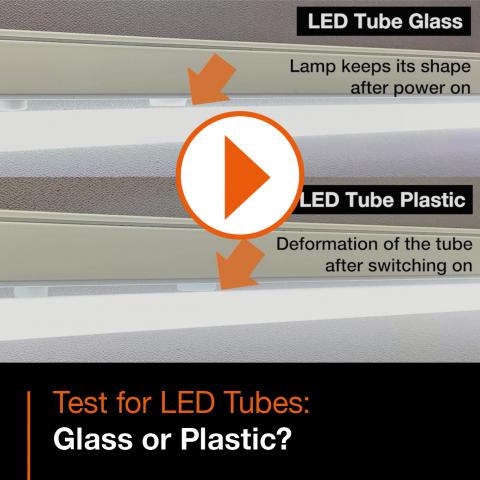
To clarify the comparison between plastic and glass tube, we have made the test for you. In our video you can see both variants before and during operation:

Go to video


In this comparison, you can see that the plastic tube already sags before switching on in the "cold" state (see graphics above left). No deformation can be seen with the glass tube.

After about one minute in operation (shown in time-lapse in the video), the plastic lamp in the luminaire has bent in the opposite direction towards the luminaire (cf. graphics above center) – the glass tube, on the other hand, remains firmly in its shape (cf. graphics above right). 

More attractive, therefore, is the variant made of glass, which comes optically very close to the fluorescent lamp. We have therefore switched our portfolio exclusively over to LED tubes made of glass*, which are provided with special shatter protection for safe use. 

To the products


Here you will also find helpful hints for determining the operating mode of your luminaire.


*Exception: T9 in ring shape 

Back to News
Feedback

Footer

  • © Radium 2026
  • Condizioni d’uso
  • CGV
  • Cookie Policy
  • Protezione dei dati
  • Condizioni di acquisto
  • Clausola di controllo delle esportazioni
  • Note legali
  • Contattaci