
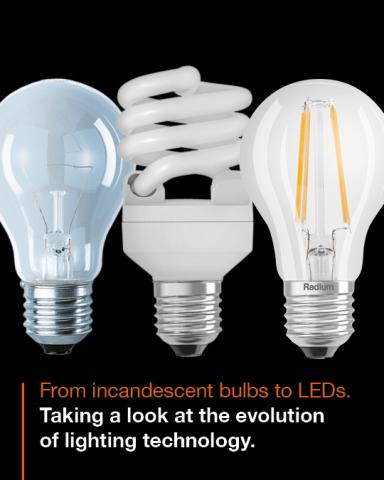
Did you know that the history of electric light began as early as the 19th century? However, it was a long road from the first experiments to the incandescent light bulb suitable for everyday use. In the late 1870s, Thomas Edison and Joseph Swan independently succeeded in developing practical incandescent light bulbs. This marked the beginning of the global triumph of electric light.
The principle behind the incandescent light bulb is simple: a thin carbon filament is heated to a high temperature by an electric current until it emits light. However, a large portion of the energy is converted into heat in the process. For this reason, increasingly efficient light sources were developed throughout the 20th century, including the halogen bulb, the fluorescent lamp, and finally the LED.
Radium’s history in electric lighting also began early on: Since its founding in 1904, carbon-filament lamps have been manufactured in Wipperfürth. Radium has now been shaping the evolution of lighting technology for more than 120 years.
How did the LED achieve its breakthrough?
The greatest technological transformation in the lighting industry began with the development of the light-emitting diode (LED). The technology achieved a decisive breakthrough in the early 1990s with the development of efficient blue LEDs. It was only then that high-performance white LEDs became possible, and they increasingly established themselves as a lighting solution starting in the 2000s.
In an LED, electrical energy is converted directly into light within a semiconductor. This makes it fundamentally different from an incandescent light bulb, in which a filament is heated until it glows. As a result, LEDs achieve significantly higher luminous efficiency, require less energy, and have a much longer service life.
Today, it’s hard to imagine everyday life without LEDs. Whether in homes, offices, industrial facilities, or public spaces, they define modern lighting and represent the next stage in the evolution of electric light.
Are you still relying on conventional light sources? Then it’s worth taking a look at Radium’s modern LED technology: www.radium.de/en/products